

How we count
What each booked inspection cost, by source
Before we touch your listing or spend a dollar on ads, we set up tracking. Each month you see the calls that became booked inspections (or estimate appointments, if that's what your shop calls them), the jobs they signed, and what each one cost.
How tracking works
One number per source
- Your Google listing gets its own tracked number as its primary phone. Your main number stays on the listing as the additional number, so nothing breaks and Google still sees the number it knows.
- Your website swaps numbers by where the visitor came from: Google, an ad, AI assistants, a directory.
- Each ad campaign gets its own number, Local Services included.
- New yard signs, truck wraps and door hangers can share one "dinner table" number, the one people read off a sign and remember.
- Calls ring straight through to you. Nobody stands in between.
Your number stays yours
Your trucks, your signs, your referrals
- Keep your main number. It stays on your trucks, your old signs and your paperwork, and every call to it still rings. We don't repaint anything.
- Calls to your main number show up in the report as their own line, so they aren't lost, only unattributed.
- Referrals are counted from "how did you hear about us?" on the call and the lead source in your CRM. Word of mouth gets its own row.
Already tracking calls?
Already on CallRail? We use it.
If you already run CallRail or another call-tracking account, we work inside it. We keep your numbers and your history, add the sources that are missing, and build the report from it. Nothing gets torn out, and the account stays in your name.
No call tracking yet? We set up an account in your name. Either way, if we part ways, the numbers and recordings stay with you.
Your CRM
Booked means what your CRM says
- We agree in writing which status in your CRM means "booked": in JobNimbus, AccuLynx or Roofr, usually an appointment on the calendar. The same statuses go into your workspace, so every page counts the same way.
- On JobNimbus, your jobs sync every morning. Other CRMs send us a weekly export.
- We write the tracked source onto the lead, so you see it in the CRM, not only in our report.
- Your office keeps booking the way it already does. We read it; we don't change how your people work.
- No CRM? A shared spreadsheet works. So does a whiteboard, if someone takes a photo of it on Fridays.
Written down before month one ends
What counts as a lead
- A person picked up, or called back the same day
- It's a homeowner or property manager
- It's work you do, in your area
- The call ran longer than 60 seconds
Not counted: existing customers calling about a job or a depreciation check, repeat calls from the same person that week, vendors, spam, job seekers and wrong numbers. We listen to a sample of calls every month to check the count. If you disagree with a call, it comes out. When Google's assistant calls for a homeowner, it counts the same way, as long as it's a real job request in your area.
If you run canvassers
Door knocking gets its own row
Plenty of storm shops knock doors. We don't, but we count it fairly, so Google doesn't get credit for your canvassers' work. With the door-knock ledger, each rep and each print run gets its own number and QR code, so the row splits by rep.
- Your CRM's lead source is the record. A lead your canvasser logged stays a canvassing lead.
- We check tracked calls against the CRM. When a homeowner was knocked first and called the Google number later, the first logged touch wins.
- Canvassing shows its leads, inspections and signed jobs. Its cost is yours to fill in, if you want it compared.
You hear it from us first
We watch every day, and email you before you notice
The story owners tell about agencies is the same one: a year in, the phone went quiet and nobody noticed. So we check every day, and when something's off you get an email from us first, with what we're doing about it.
- Calls below 70% of your usual week, or more than 15% unanswered
- One tracked number that usually rings going quiet for a week
- Your website down or slow
- Your Google listing missing from the map, or its phone, website, category or name changed
- No new reviews in 30 days, or your rating slipping
- Your top-3 map coverage down 10 points or more against the last comparable scan
- A competitor taking a big piece of the map, or piling on reviews
- Review requests that stopped going out, or a CRM that stopped updating
- 1-inch-plus hail near your office, which starts your storm plan
Day one
"What would make you fire us?"
We ask it at the kickoff and write the answers down. They become the checkpoints at 30, 60 and 90 days, in your words, not ours.
And each quarter the report ties what we did to what moved: "we changed this, and calls from that town went from 6 to 11." When nothing moved, it says so.
In your workspace, every piece of map work we log gets its own verdict a few weeks later: did your top-3 coverage go up, down, or is it too soon to tell, against what your main competitors did over the same weeks. It's evidence, not proof of cause, and it shows the misses too.
The report reads on its own. If the person who hired us leaves, you can still tell in two minutes whether it's working.
Sample report · made-up numbers
What the report looks like
The numbers are invented to show the format. They add up to a real plan: Maps and site at $2,750 a month, plus ads management at $900/mo on $5,000 of ad spend. Signed jobs and revenue use a rolling three months, so a storm month or a slow month doesn't swing the cost per signed job.
| Source | Calls | Leads | Booked inspections | Cost | Per inspection | Signed (3-month avg) | Revenue | Per signed job |
|---|---|---|---|---|---|---|---|---|
| Google listing | 41 | 22 | 11 | $1,375 | $125 | 4 | $60,000 | $344 |
| Website (search) | 18 | 9 | 4 | $1,375 | $344 | 1 | $14,800 | $1,375 |
| Google Ads (search) | 22 | 9 | 4 | $2,850 | $713 | 1 | $15,500 | $2,850 |
| Local Services (Performance Max) | 19 | 8 | 4 | $3,050 | $763 | 2 | $29,000 | $1,525 |
| Yard signs and trucks | 7 | 5 | 3 | $0 | $0 | 1 | $16,000 | $0 |
| Referrals and word of mouth | 11 | 8 | 6 | $0 | $0 | 3 | $47,500 | $0 |
| Canvassing (from your CRM) | · | 12 | 9 | yours | · | 3 | $48,000 | · |
How the cost column is built
Our plan fee is split evenly across the unpaid sources we work on: here, $2,750 across the listing and the website, $1,375 each. Each ad campaign carries its own spend plus an even share of the ads fee. The rule is printed on every report, and you can ask for a different one.
Underneath the table
Missed calls and how many were returned, after-hours calls, and one paragraph on what changed and why. What's missing on purpose: website visits, rankings and impressions. They show up only when they explain a change in inspections.
Storm months get their own table
| Source, storm week | Calls | Answered live | After hours | Booked inspections | Inspected within 72 hours |
|---|---|---|---|---|---|
| Google listing | 96 | 81 | 23 | 38 | 31 |
| Local Services (surge plan on) | 64 | 55 | 19 | 27 | 22 |
| Storm town pages | 29 | 25 | 8 | 13 | 11 |
Between reports
Your workspace, any day you want to look
The monthly report is the summary. Your workspace has the same numbers live, from your CRM and your tracked calls, plus a short email every Monday.
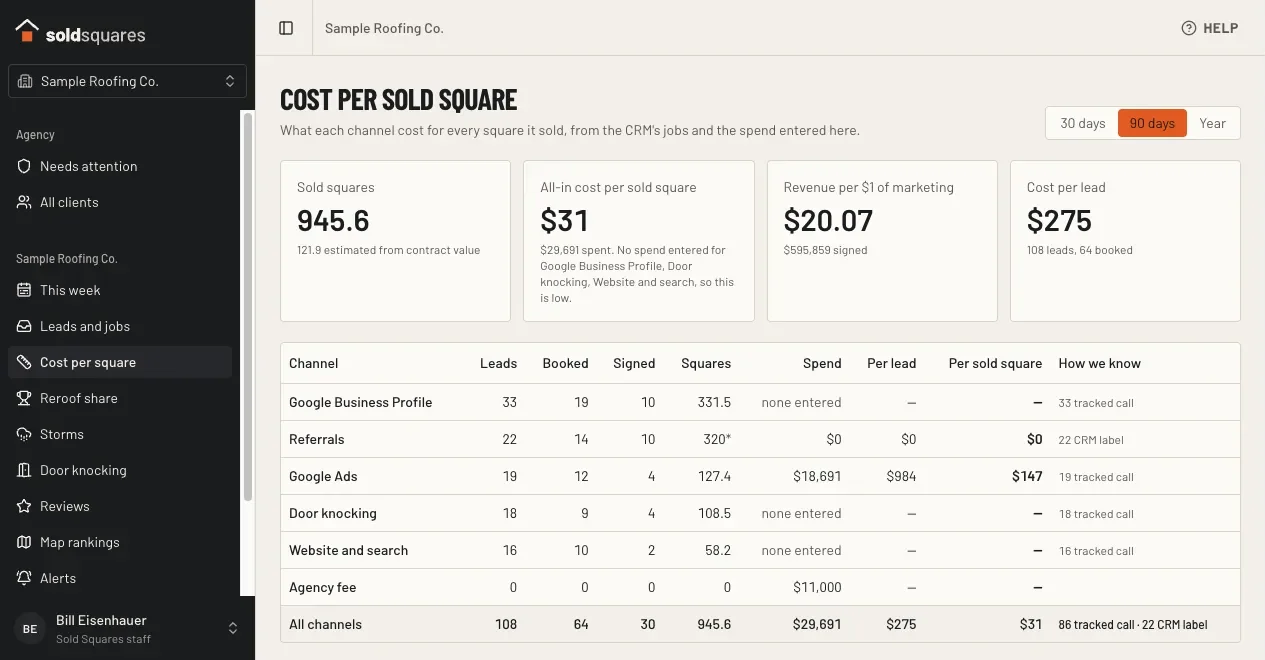
Cost per sold square
What each channel cost for every square it sold, and the all-in number with our fee in it. Each job gets its channel from the strongest evidence we have: a tracked call from the same phone first, then a call-back from a rep's page, then the source your office typed in. A channel with no spend entered shows no cost, because unknown isn't free.
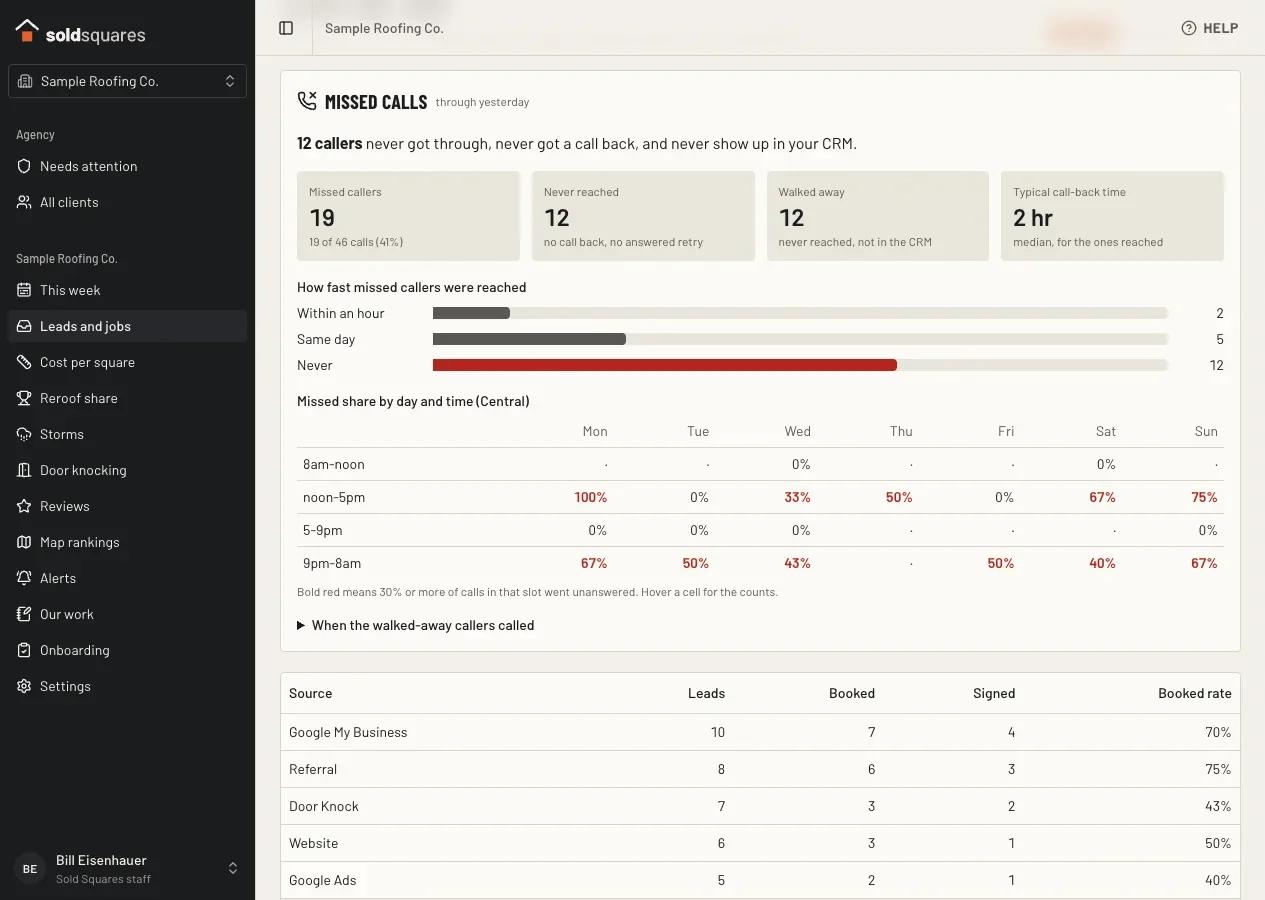
Callers who walked away
Missed callers who never got a call back and never turn up in your CRM, counted. Plus how fast the rest were reached, and which days and hours your phone goes unanswered, so you know when to put someone on it.
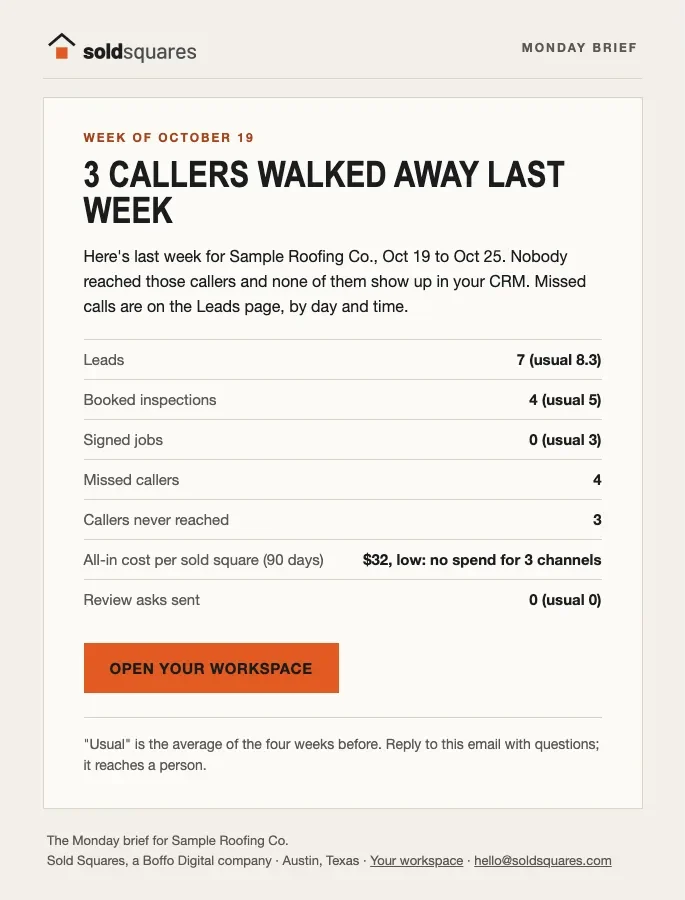
The Monday brief
Last week in one email, against your usual week: leads, booked inspections, signed jobs, missed callers, and your all-in cost per sold square. It leads with the line that matters most, like "3 callers walked away last week."
Your lead count drops in month one. Then it means something.
Right now, every ring probably counts. Once spam, vendors, existing customers and 15-second hang-ups come out, the number shrinks. That's the real starting line. Everything after it is measured from there.
Call recordings
Calls are recorded so the count can be checked, with a short notice at the start of each call. Texas allows one-party recording, but your callers might be somewhere that doesn't, so the notice plays on every call. The recordings live in the call-tracking account in your name, and you set how long they're kept. We listen only to check the count, and we lose access the day you leave. More on privacy.
For the office manager
What lands on your office
- Tagging calls: us, not you. We sort the calls each week and send you the handful we're unsure about.
- Booking: exactly what you do now, in your CRM.
- Review asks: sent by your CRM or our tool when a job closes. You don't send them by hand.
- Photos: the crew lead texts us five photos per job (before, tear-off, deck, finished, truck in the driveway). We sort and post them.
- Logins: one list in week one, then nothing.
We aim to keep it under 30 minutes a week of office time. If it's more, tell us and we'll fix the process.
Questions
Who decides if a call counts?
The written rules you agreed to. If you disagree with a call, it comes out.
What about web forms?
Counted the same way: a real person, real work, in your area, and you reached them.
Can I hear the calls?
Yes, every one. They're in the call-tracking account in your name.
Do I have to change the number on my trucks?
No. Your main number keeps working everywhere it already is, and calls to it show up in the report as their own line. Tracked numbers go on your Google listing, your site, your ads and any new signs.
Free audit
See where your calls come from.
A free 30-minute call audit: where you show up on the map, what your listing and site get wrong, and two test calls to your own line. You keep the written audit whether you hire us or not.