

S · Storm season
When hail hits, you're already the local roofer
Storm chasers show up with door hangers and a new phone number. You've got a real address and years of jobs in town. We get that in front of homeowners before the first hail call, and keep your phone answered when the calls stack up.
When hail comes
Built before the first hail
In Central and North Texas, hail season runs roughly March through June, and in Central Texas it peaks in May. Up in the Panhandle it runs later, May through September. The plan follows your towns, and the storm work gets built in the off months, when you've got time to answer our questions.
A storm page for each town
Your local address, your insurance certificate, "registered with the City of ___" where that's true, "RCAT Licensed Roofing Contractor" if you hold it, and photos of storm work you've done there. Texas has no state roofing license, so the page never claims or implies one.
An ad surge plan you approve now
Which towns, a budget cap, and what triggers it, like hail reported in your towns. No 2 a.m. phone calls asking for permission.
After-hours coverage, tested
An answering service or a forwarding plan, and we call it ourselves to make sure it works.
Missed-call text-back
Registered with the phone carriers so the texts actually arrive, and kept to a plain reply to the caller, never a promotion.
The morning after
Hail alerts for your towns
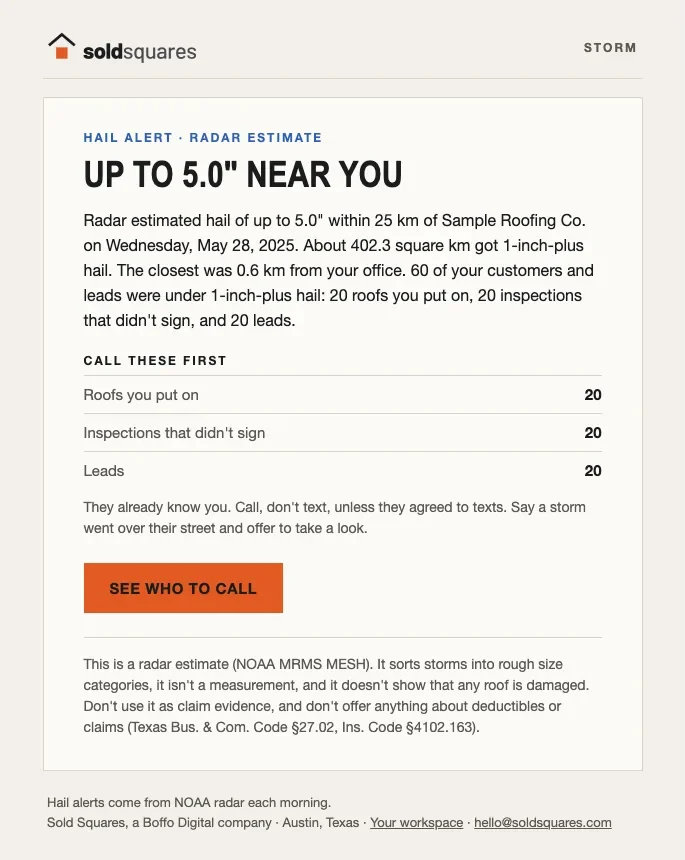
Every morning we read NOAA's radar estimate of hail size for Central Texas, on a grid about a kilometer square. If 1-inch-plus hail fell within the distance we set with you, you get an email before your phone starts ringing: where it fell, how big an area, and how close to your office.
Your report keeps every storm day near you since 2020, with a map of each one, so you can see which towns get hit year after year.
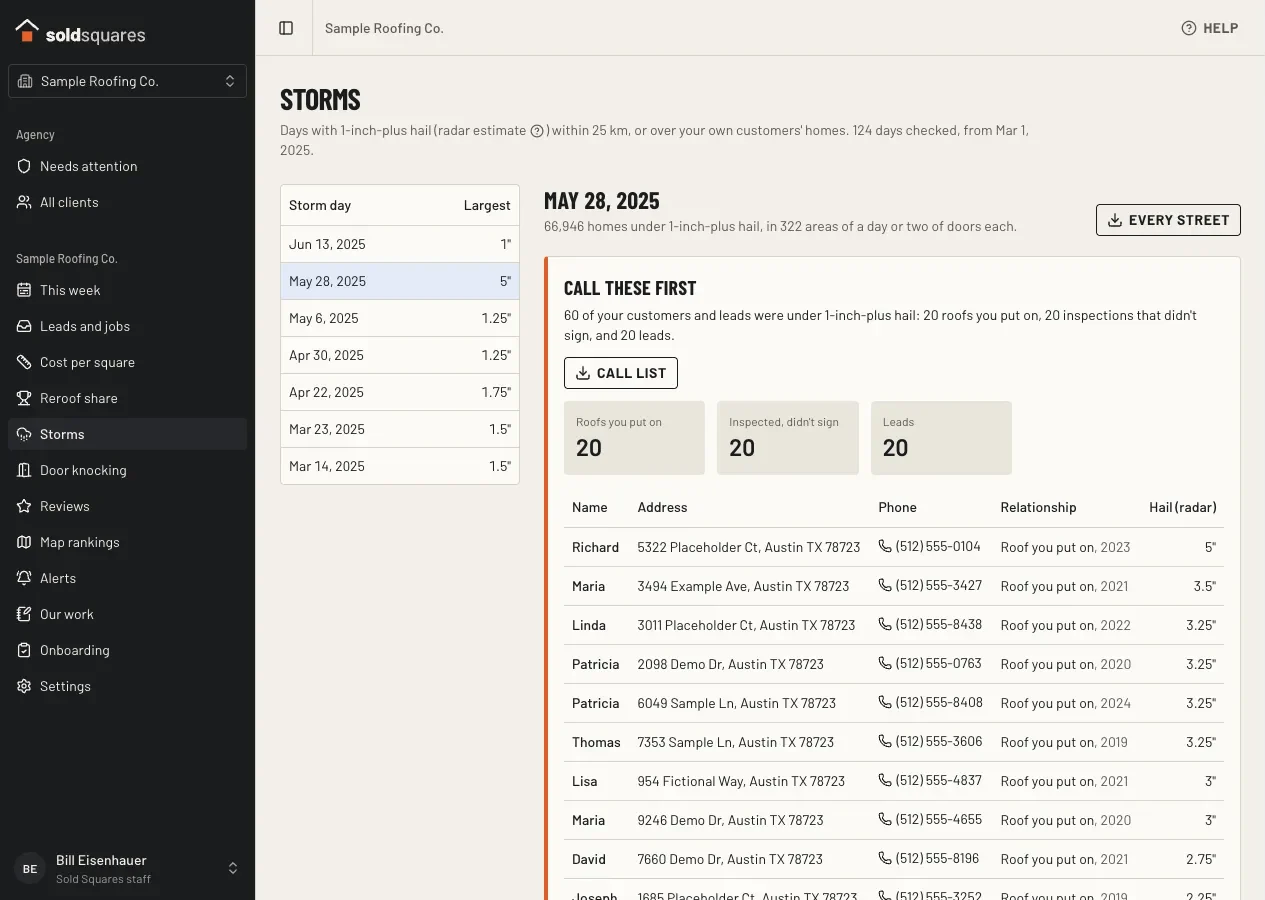
With county records, a storm becomes a street list: the streets under the hail, how many homes on each, how many look owner-occupied, when they were built, and whether a roof permit is on record since the storm. We group the streets into rep-sized areas, show every home on a street map, and rank the areas to knock first. Your reps get the streets and the storm date. If another client works the same storm, no street goes to both of you: inside your home area the streets are yours, and outside it they go to the closest office. How it fits door knocking.
Radar sorts storms into rough sizes, and it runs high: on May 28, 2025 it estimated stones near 5 inches where spotters reported 2. A hail map says where hail fell. It doesn't say any roof is damaged, and it isn't claim evidence. Only an inspection tells you that.
Most re-roofs never get a permit, so "no permit on record" never means a roof wasn't replaced.
The morning after
Call your own customers first
The best calls after a storm go to people who already know you. The hail email starts with them: every past customer and lead from your CRM whose home sat under 1-inch-plus hail, split into roofs you put on, inspections that didn't sign, and leads.
One click gets the call list: names, phones and addresses, and no hail sizes. If the storm missed your office but went over your customers' homes, you still get the email.
Call, don't text, unless they agreed to texts. Say a storm went over their street and offer to take a look.
For your reps
A knock list on every rep's phone
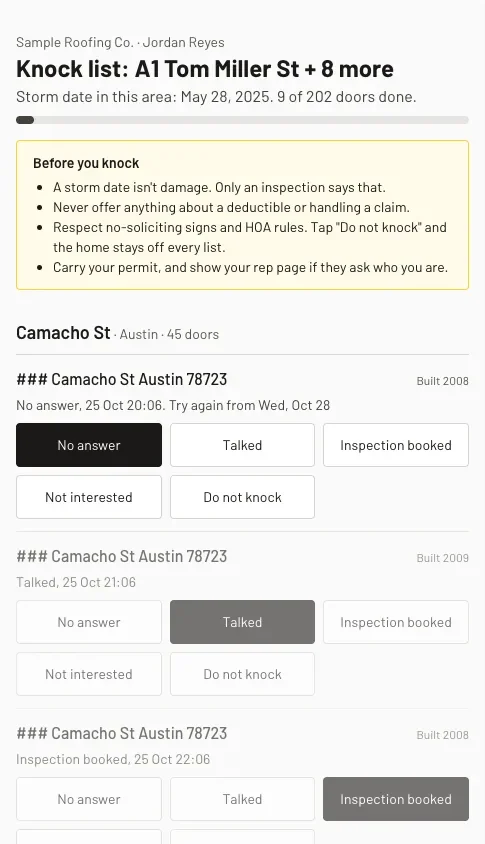
Assign an area and the rep gets a link. It opens on any phone, with no app and no login: every home in walking order, up one side of the street and back down the other, one tap per door. A no-answer comes back to try again two days later. "Do not knock" stays on the home, on every list after, until you clear it.
The list carries the storm date, never a hail size. When you hand the area back, or the rep leaves, the link stops working.
Each tap lands on your Storms page: doors knocked, people talked to and inspections booked at the door, next to the jobs your CRM signed in that area.
Permits name the contractor. For each storm we show which companies pulled reroof permits on homes under the hail in the months after. City of Austin only for now: it's the one city that publishes the contractor's name. Most reroofs never get a permit, so it's a share of permitted reroofs, not of every roof replaced.
The week of the storm
When it hits
Ads turn up on the plan you already approved. Your Google listing gets a storm update. QR codes on your yard signs and hangers can switch to your storm page with one change, no reprinting. We watch call volume and how many calls got answered, every day, and tell you if the after-hours line is dropping calls.
Remember who gets the job: whoever calls back first. Some of those calls may come from Google's assistant phoning on a homeowner's behalf, so a live answer counts twice.
After the storm
Storm months get their own report
A hail spike can hide a slow retail month. It can also make us look better than we are. So storm months are reported on their own, next to your normal months. The months in between have their own plan.
Texas law and plain sense
What we'll never put on your storm pages
- Any hint that the roof costs the homeowner nothing
- Anything about the deductible. Texas law bars advertising around it (Bus. & Com. Code §27.02)
- Any offer to take over, argue or negotiate the homeowner's claim. Texas bars roofers from acting or advertising as public adjusters, and the state counts a website as advertising (Ins. Code §4102.163). What's fine: the inspection, photo documentation, meeting the adjuster
- Promises about what the insurance company will approve
- A percentage off insurance for impact-rated shingles. Each insurer sets its own discount, so the page says "ask your insurer"
- A free inspection as the headline. It's what storm chasers lead with. It can sit in the body copy
- Countdown timers or "only 3 inspections left this week"
- A claim that searches jump some multiple after a storm. Nobody has published real data on it
Questions
There are storm chasers in my area.
We can't stop them knocking doors. We can make sure that when a homeowner searches, the roofer with a local address and a history in town shows up first, and that somebody answers the phone. If a chaser posts a fake listing, we'll report it.
Do you do door knocking?
No. But if you run canvassers, we count their leads next to ours, from your CRM, so Google doesn't get credit for their work. How that works.
Can you surge ads into a town I don't usually work?
Only if you'll actually serve it and answer those calls. Otherwise you're paying for calls that go to voicemail.
Free audit
See where your calls come from.
A free 30-minute call audit: where you show up on the map, what your listing and site get wrong, and two test calls to your own line. You keep the written audit whether you hire us or not.